Resilient Like Fireweed
Author: Jennifer Ching * Surviving Spouse of Air Force MSgt Temujin Ching
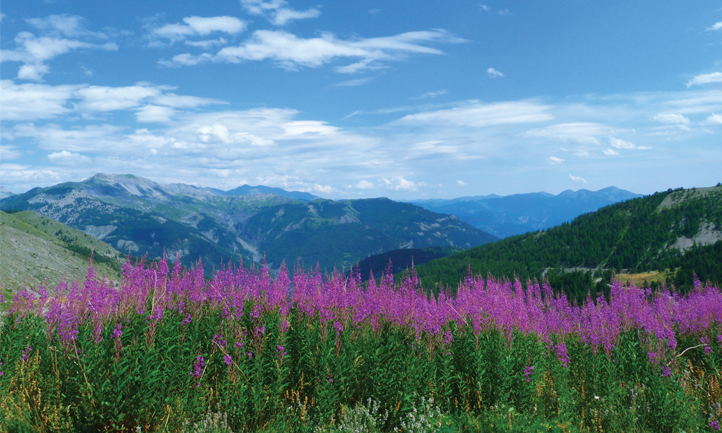
In Alaska, fireweed is a familiar sight in summertime. With highways and roads lined with a never-ending green of vegetation, its bursts of beautiful hues of pink, magenta, purple, and the occasional rare white blossoms are a welcome contrast. It’s often used as a measurement of time in Alaska. The flowers bloom from bottom to top, and when the blossoms at the top are starting to seed, it signals summer is ending and winter is near. Fireweed is also one of the first plants to dot the landscape after fire devastates an area, bringing back life to the scorched earth. Its deep roots protect it from being completely destroyed. As a result, fireweed is often a symbol for resilience, hope, and regrowth. It represents the ability to recover and flourish after devastation.
I moved to Alaska in February 2008 after accepting a promotion with my then-employer. I felt stagnant in my life and craved an adventure. I had never been to Alaska before and didn’t know anyone. I remember getting into the rental car at the airport. It was negative 20 degrees. As I waited for the car to slowly warm up, I cried uncontrollably. I was alone in a strange new place. It was cold and dark — really cold and dark. I wondered if I had made the biggest mistake of my life. The next day, when I showed up for my new job, one of the first people I met later became my husband of nearly 15 years.
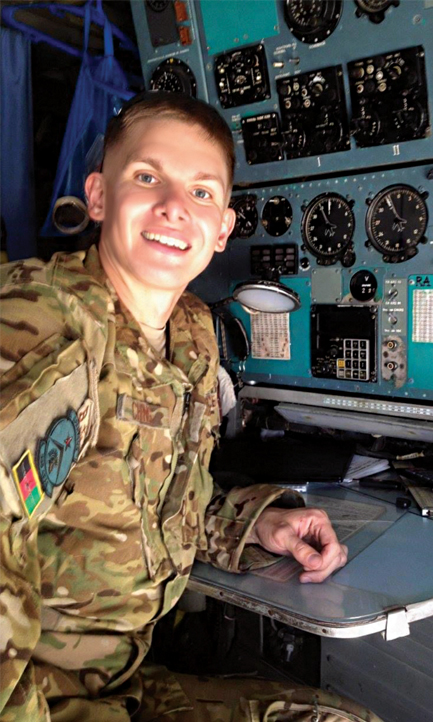
I lost my husband, MSgt Temujin Ching, to suicide on Jan. 3, 2024. He had over 20 years of military service and was headed toward retirement. During his career, he held various positions in the Air Force, Air Force Reserve, and the Alaska Air National Guard, but he was proudest of his time with the 210th Rescue Squadron as a special mission aviator. He loved the mission and enjoyed taking in the remoteness of Alaska from the back of a Pave Hawk helicopter. He executed many rescue missions and was awarded numerous saves. His work gave him a sense of purpose and pride. It helped him fight his dark thoughts for as long as he could. He truly embodied the motto: “That others may live.”
Resilient — I heard that word countless times after my husband’s passing. It was offered as a word of comfort, meant to remind me of my strength during the worst moments of my life. I struggled to believe it. I often thought, “I’m not resilient. I just have no other choice.” I had three wonderful children who just lost their father. They needed their mother to be strong, now more than ever.
I couldn’t let the burn of grief consume me. I had to find the fortitude to keep going, to keep showing up for them and myself.
After Temujin’s celebration of life, I wanted something personal and permanent to honor my time in Alaska — the life I built there, where I fell in love, where I married, where my three babies were born and raised, and where I lost my husband. For years, I wanted a tattoo, but Temujin hated tattoos. Out of respect for him, I never got one. So in a moment of defiance, thoughts of “You should have stuck around…you can’t stop me now,” ran through my mind as I sat in the chair at the tattoo shop.
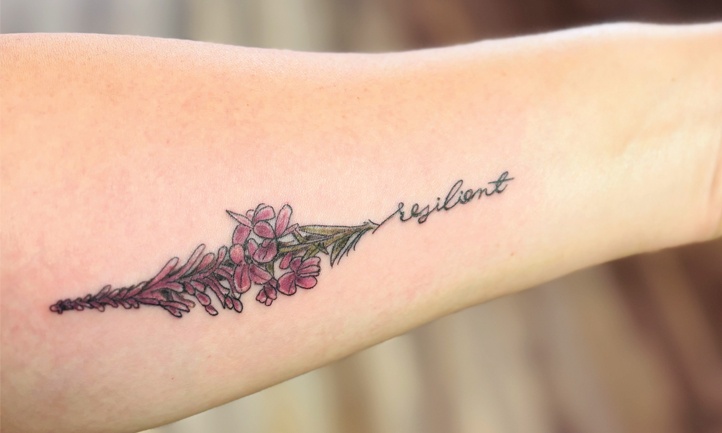
I decided on fireweed growing from the word “resilient” on my left forearm. It’s my daily reminder that beauty and life can resurface after devastation, that I chose to endure and persevere despite it all.
As survivors, we find many ways to remember our loved ones. We wear bracelets engraved with their names. We have plaques hanging up with their photographs. Medals, helmets, flags, and other tokens of their military service sit on our mantels and bookshelves. Some of us even get tattoos to memorialize them. We eat meals at their favorite restaurants on their birthdays. We post pictures and memories on social media. We share stories of them at the dinner table. All of these things we do to remember them are crucial for healing. We keep their names spoken and their memories alive in their absence.
Still, as survivors, we can become so focused on honoring those we lost that we forget to honor ourselves. A lot of our identity is ripped from us when we lose a loved one, especially a spouse. Part of resilience is allowing time to heal, but for us to truly heal, we need to learn how to grow again. Fireweed reminds us of nature’s remarkable ability to regenerate after devastation — to not just survive, but find a way to thrive after devastation.
May we, as survivors, be as resilient as fireweed. May we, as survivors, take root as deeply. May we find a way to bloom again.
Access suicide-loss support through TAPS.
›› TAPS.org/Suicide
PHOTOS: Jennifer Ching; iStock