Crackled, Not Broken: A Raku Reflection on Grief and Grace
Author: Gregory T. Jacobs * Surviving Father of Army SPC David Jacobs
On a recent trip to the Smoky Mountains, my wife and I found ourselves, once again, at one of our favorite artisan spots — Alewine Pottery, quietly nestled among the pines and whispering winds of Gatlinburg, Tennessee. Over the years, I’ve grown fond of their artfully crafted mugs, each one a small masterpiece that somehow makes a morning cup of coffee feel like a ritual.
But this visit was different. This time, they were offering something new — an interactive exhibit in Raku pottery, a traditional Japanese firing method unlike anything I’d seen before. I signed up without hesitation, unaware of just how deeply this experience would stir my spirit.
The Art of Fire
Raku is not your everyday pottery. The process begins like most: A formed and glazed pot, carefully prepared, awaits its final transformation. But, instead of a slow, even bake, the pot is placed into a red-hot kiln reaching nearly 1,900 degrees. Then — at its peak temperature — it is abruptly pulled into the open air.
That rapid thermal shock causes the glaze to crackle unpredictably and beautifully.
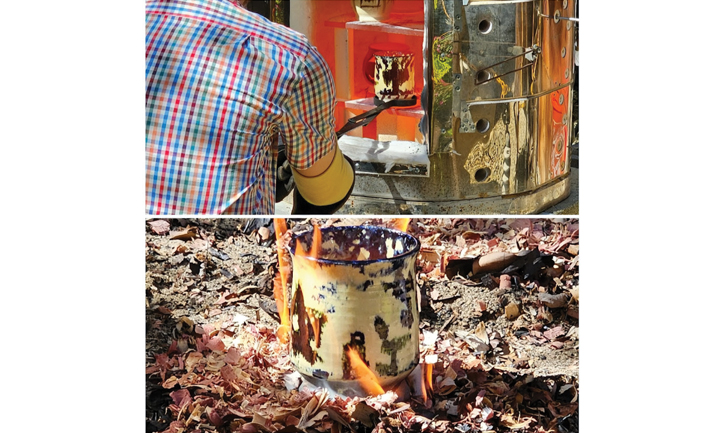
The red-hot pot is then placed into a metal bin filled with combustible material — in our case, cedar chips and old newspapers, which causes flames to erupt instantly, licking around the vessel before a lid is sealed tightly over the container. Starved of oxygen, the fire devours everything inside, and the smoke infuses the pottery with deep blacks and rich, earthy hues.
Finally, once the piece has cooled, it’s scrubbed with steel wool or a Brillo pad, slowly revealing what the fire has made.
Painting With Meaning
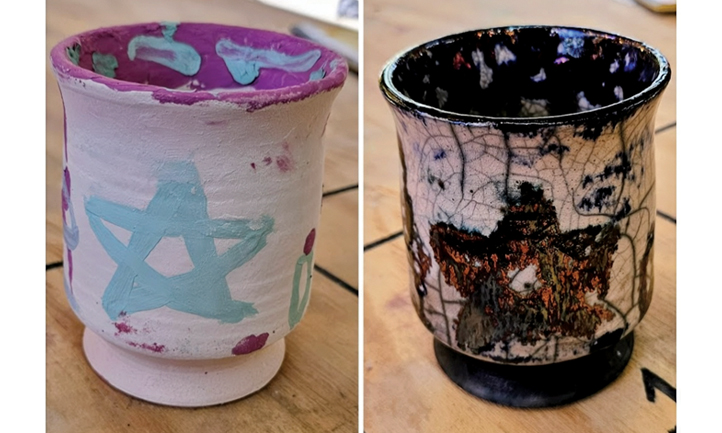
Before the kiln, I was handed a spun and pre-glazed pot — a blank canvas. I was only given two colors: cobalt, which appeared pink but would turn blue in the fire, and copper, which started as a pale bluish tint but would later reveal warm, metallic tones.
I thought carefully about what to paint. I chose three simple, yet profoundly meaningful symbols: a gold star, cross, and D.J. — my son’s initials.
Every brushstroke was deliberate. I tried to keep my lines straight, appeasing the tidy, orderly part of my mind that still longs for control. Yet I knew, deep down, that the fire would change everything.
And it did.
Into the Fire
As the potter reached into the kiln with metal tongs and lifted my glowing, molten pot, a wave of anxiety washed over me. Had I made a mistake in my design? Would the pot survive the shock of the fire? Would the lines I painted remain clear — or melt into chaos?
Flames erupted around it as it was placed into the cedar chips. Newspapers were added, and the entire piece disappeared under smoke and fire. Then came the sealed bucket, snuffing out the oxygen, leaving my pot in darkness to smolder.
When the pot was finally removed and cleaned, I stood in silence as the soot was scrubbed away, revealing the unexpected beauty that fire created. And in that moment, I wept.
I cried not for the pot — but for the journey it mirrored.
Before and After
On Dec. 23, 2020, my son, David, was killed in an auto accident just outside Fort Carson, Colorado. Since that day, my life has been irrevocably split into two parts: before David died and after David died.
Before, I lived like that unfired pot — untested, polished, with straight lines and a false sense of permanence. I subscribed, unknowingly, to the easy notion that “ignorance is bliss.” Life made sense. My lines were straight. My hands were steady.
After, it was as if the kiln doors flung open and I was thrust into the fire. My sails were shredded. My compass, lost. The life I knew was covered in soot and ash, and everything felt fractured and unrecognizable. The lines of my identity blurred. The colors of hope ran together.
But something began to change — slowly, almost imperceptibly.
Becoming Something New
It started with community. I began to open my life to others on similar grief journeys. I allowed space for vulnerability, for therapy, for sacred companionship. And just like the pot emerging from fire and soot, I began to see a new kind of beauty forming — not in spite of the cracks, but because of them.
Like Raku pottery, I am now a vessel that holds truth and emotion without trying to hide the imperfections. The glaze of my life is crackled. Some lines are crooked. The colors have shifted. But, the result is something wholly unique — distinguished by fire, and resilient through grace.
This is not a story of brokenness and repair. It’s a story of transformation.
The Road Around the Mountain
As we left Alewine Pottery that day, the road gently curved around the mountain, like a slow-turning potter’s wheel. I stared out the window in quiet reflection. I came to make pottery, but what I received was a glimpse of the man I am becoming — shaped not only by loss, but by love, fire, and the courage to keep turning on the wheel.
I am not who I was before. But I am not broken. I am crackled — and beautifully so.
For more content from Gregory, listen to his podcast, Turning Grief Into Growth: The Journey of Transformation.
Find community through shared experience.
PHOTOS: Gregory T. Jacobs