Words Will Never Be Enough
Author: Ava Henrickson, Surviving Mother of U.S. Army SSG Adam Henrickson
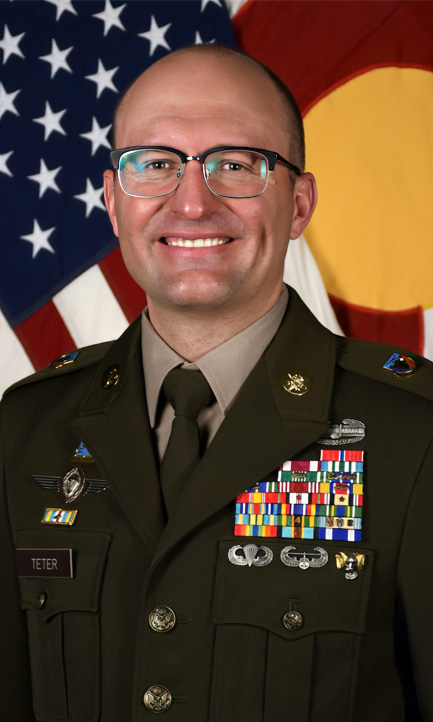
First Sergeant Ryan Teter’s 20-year military career in the Colorado National Guard has been peppered with many memorable and commendable acts of service. For months at a time, he was called away from his family, serving in Korea, Iraq, Bahrain, and Afghanistan — not to mention the training and temporary duties in between. As a leader, he’s shaped the careers and attitudes of younger soldiers, while pursuing his own career goals.
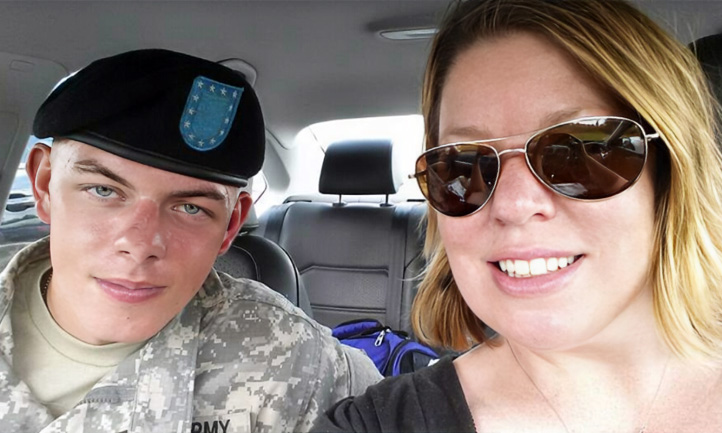
His most rewarding mission, though, had him drawing on skills he didn’t know he had. It taught him a lot about himself, the military, death, and compassion. When my only son and youngest child, SSG Adam Henrickson, died of suicide on Sept. 10, 2020, in Ruschberg, Germany, 1SG Teter became my casualty assistance officer (CAO), acting as the liaison between the U.S. Army and me. I was notified of Adam’s death by an Army chaplain and notification officer around midnight that night. My world crumbled — the absolute worst thing that could happen had happened to me.
I met 1SG Teter two days after the notification when he came to my house for our first meeting. I opened the door that Saturday morning and saw a soldier dressed for battle. His kind eyes looked back at me — a moment of peace. He appeared to be as nervous as I was, neither of us knowing what to expect. It may have been at that initial meeting when he told me this was his first CAO assignment.
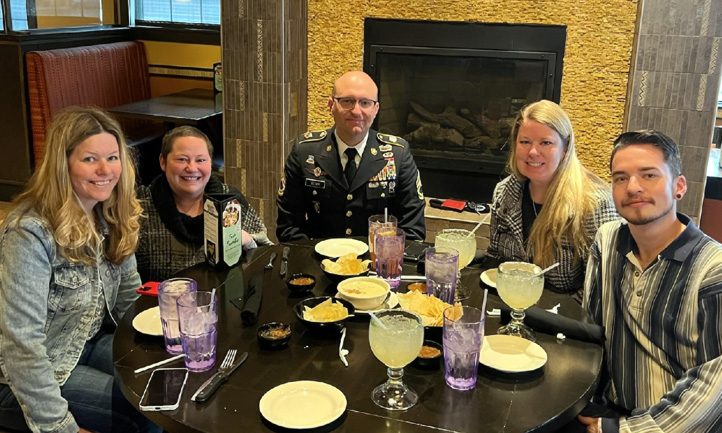
He arrived to a living room full of my people — with more on the computer, on Zoom. We all had questions for 1SG Teter, most of which he didn’t have the answers to — not because he wasn’t prepared, but because that’s the nature of the duties of a casualty officer. As 1SG Teter explained it, himself, getting through the next six months or so would be like eating an entire elephant: one bite at a time.
“I knew going in the first day that I was going to have to say, ‘I don’t know’ a lot, and that’s difficult to hear,” he recalled. “It’s a very good lesson in empathy.”
But it wasn’t nerves, exactly, that 1SG Teter was feeling that first day:
“I knew it would be a challenge, but I found the [CAO] training engaging. I saw the purpose of doing it, and I felt ready, but I also felt a lot of anxiety. Fortunately, a lot of other training I’ve had in the military taught me not just about how to handle stressful situations, but about communication and getting through giant conversations, so I felt prepared.”
That doesn’t mean it was easy. “It turned out to be far more complex than I took it at face value,” he said.
The biggest challenge 1SG Teter said he faced at the time was Covid. The pandemic caused delays and changes in the way things were normally done — the way he was trained. Another challenge was the eight-hour time difference between Germany and Colorado.
But, 1SG Teter was used to challenges. He deployed three times, supporting Operation Enduring Freedom, Operation Iraqi Freedom, and Operation Spartan Shield. He shared that he’s learned a great deal during his service experience, but his training — and ultimately his assignment — as a CAO made him look at things differently, at work and at home.
When 1SG Teter took the CAO assignment, his daughter was only 8 weeks old. While his wife had been through deployments, this was a new challenge for the new mom.
“My wife is exceedingly patient and supportive of the National Guard. So, she understands and has continued to understand that if I get a call, I have to go,” said 1SG Teter. “For her, it was probably easier to understand why I had to be fully committed to this thing. The challenge was being emotionally tied up with the CAO case and having nothing left emotionally after that, and not being the most emotional person to begin with.
“My wife has a very strong sense of duty. In a way for her, if she backs me up, it’s like her form of service,” said 1SG Teter.
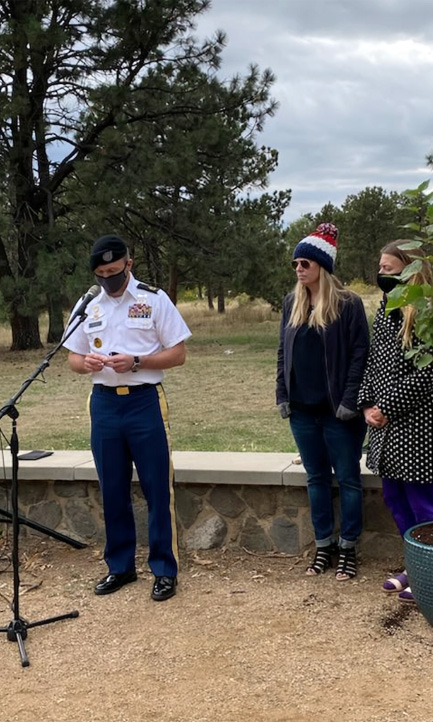
Despite his belief that he was not an emotional person, 1SG Teter went above and beyond the call of duty during those days when I was in immense grief. He offered a shoulder to cry on, explained how the military worked, how cars worked, and always offered a nonjudgmental space where my feelings could flow. The morning before Adam’s celebration of life, 1SG Teter came over early to place my son’s Army pins, medals, and commendations in the box that held the flag from his casket — now ceremoniously folded to fit the triangle-shaped box.
Facing death and death-related decisions is not easy, and 1SG Teter said Adam’s death had a profound influence on him. “It impacted me in a way, and I tried to channel what I learned into my soldiers,” he said. “Something profoundly negative happened, what positive can we leverage out of it?” He was able to help his soldiers think about what’s important in life. “That motivation on my part was extremely pure,” said 1SG Teter.
All the lessons 1SG Teter collected along the way served a greater purpose; 1SG Teter said that being a CAO “was the best preparation possible to be a First Sergeant,” which he became a few months after he served as a CAO. In fact, he thinks the CAO course should be mandatory for all soldiers because of how well it explains all the military forms and death benefits.
After my son’s death, 1SG Teter changed the way he had his death gratuity payment set up, in that not all of it would go to his wife; a portion would go to his family member, a portion to one of his wife’s family member, and a portion to a friend, for very good reason.
Even though they insisted they didn’t want his money, 1SG Teter responded, “This money is so that you can stop what you’re doing and go take care of my wife and kid [if something happens to me].”
And even though he didn’t know my son, Adam, he felt like he knew him throughout this process of helping me navigate his death and all the duties that came with it. “I recognized him in my soldiers,” said 1SG Teter. “Never having met him, I felt like I could recognize him in myself, too. I think I felt some connection and went through the process.”
My son was a hard worker — an Army mechanic who loved to work on German cars in his spare time. He also traveled all around Europe and took beautiful pictures. His death by suicide was a total shock; we all thought he was living his best life.
According to data from the U.S. Department of Defense, Adam was one of 406 active-duty military members to die by suicide in 2020 out of a total of 1,017 active-duty deaths that year. Many of those who died had family members who were assigned a CAO. And, if they were lucky, they got one as good as 1SG Teter. He became like family throughout the months-long process of closing out my son’s affairs, and we stay in touch, years later. Maybe it was his duty to help me, but it was his humanness that bonded us. I think my sister, Angie, said it best: “I just want to say ‘thank you’ — for being available 24/7, putting your life on hold, for letting us scream and holler and holding us as we cried. Words will never be enough to express our gratitude.”
 PHOTOS: Ava Henrickson